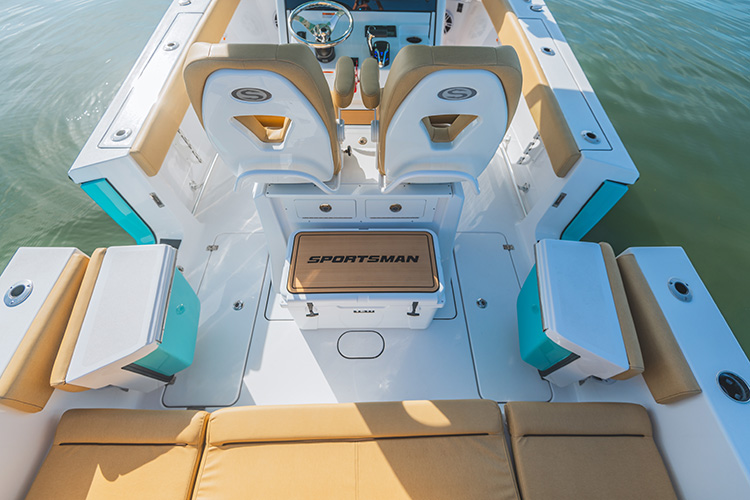
Open
Built for families who want serious offshore capability,
premium comfort and the freedom to fish, cruise or entertain.
Open 402
NEW Open 352
NEW Open 322
NEW Open 302
Open 282
Open 262
Open 252
Open 232
Open 212
Heritage
A refined crossover lineup designed for coastal cruising, ample seating,
family days and some fishing when the moment calls for it.
NEW Heritage 321
Heritage 261
NEW Heritage 251
Heritage 231
Masters
Shallow-water performance, fishing-focused layouts and
everyday comfort built for family life and fishing.
Perfect blend of offshore capabilities with inshore conveniences.
NEW Masters 288
Shallow-draft bay boats built around casting space, livewells and skinny-water fishing.
Masters 267
Masters 267OE
Masters 247
Masters 247OE
Masters 227
Choosing the right size center console isn’t about going bigger, it’s about finding what fits your lifestyle. This guide breaks down how size impacts performance, trailering, storage, cost and overall experience on the water.

-
•Size the boat to your everyday routine, not your dream offshore trip.
-
•A mid size boat around 24 to 28 feet offers a balance of space and trailerability.
-
•Larger boats provide more range and comfort but come with higher costs and more maintenance.
Choosing the right size center console is one of the most important decisions you’ll make when buying a boat, and it’s usually not as simple as going bigger or staying smaller.
It comes down to how you actually use the boat.
A lot of people start by thinking about where they want to go. Inshore, nearshore, offshore. That matters, but it’s only part of the picture. The better question is how you spend your time once you get there.
If your days are built around quick trips, hitting a few spots and getting back to the dock, a smaller center console makes a lot of sense. Boats in the low 20-foot range are easy to trailer, easy to store and efficient to run. They’re perfect for fishing inshore, cruising the harbor or making short runs on calm days. You spend less time managing the boat and more time actually using it.
But as your plans start to stretch, the size of the boat starts to matter more.
Once you move into that mid-size range, call it 24 to 28 feet, you start to feel the difference. There’s more room to move, more seating for family and friends and a hull that can handle a wider range of conditions. It opens the door to longer runs and more flexibility while still giving you the ability to trailer the boat without stepping into a completely different level of ownership.
This is where a lot of people land, and for good reason. It’s a balance.
Then there’s the next step.
When you get into the 30-foot and up range, the experience changes completely. You’re not just going out for the day anymore, you’re planning around the boat. Longer offshore runs, full days on the water and even overnight trips start to feel realistic. You gain cabin space, larger fuel capacity, more power and systems that support staying out longer.
Comfort becomes just as important as capability.
With that shift also comes a different approach to how you own and use the boat.
Smaller boats, generally 26 feet and under, are often ideal for trailering. They’re easier to tow with a wider range of vehicles, simpler to store at home and more flexible if you like to explore different waterways. You can launch where you want, when you want, without relying on a marina.
As boats get larger, trailering is still possible but becomes more involved. Bigger tow vehicles, increased fuel usage while towing, potential for oversize permits and the experience needed to move a larger load all start to factor in. For many owners, this is where the transition happens.
Instead of trailering, larger boats are often kept in dry storage at a marina or on a lift at a private dock. That convenience changes everything. You’re not thinking about ramp lines or long drives with a trailer, you’re stepping on the boat and going. It’s a different kind of access to the water, and for a lot of people, it’s a better one.
Ownership costs scale in a similar way.
Larger boats typically come with more power, more systems and more onboard features. That means higher fuel capacity, additional engines in some cases and increased maintenance compared to smaller models. Storage costs can also increase depending on where and how the boat is kept.
But those changes come with real benefits.
More range, more comfort, more capability and more time on the water without compromise.
For someone who has easy access to the water, whether that’s a dock at home, a nearby marina or a lifestyle built around being on the water often, stepping into a larger boat makes a lot of sense. It removes friction and turns boating into something that feels more natural and more frequent.
On the other hand, if flexibility, lower operating costs and simplicity are priorities, a smaller or mid-size boat can deliver an incredible experience without the added layers of ownership.
One of the biggest mistakes people make is buying based on what they think they might do instead of what they actually do.
If most of your time is spent fishing local waters, running sandbar trips and keeping things simple, a smaller or mid-size boat will likely get used more often. It’s easier to grab and go, and that matters more than people realize.
If your goal is to run offshore consistently, bring a full crew and stay out longer, sizing up early can open the door to a completely different level of boating.
There’s also the family factor.
More people means more space. Seating, storage and overall layout start to matter just as much as performance. A boat that works perfectly for two people can feel tight with six. Thinking about who’s coming with you is just as important as where you’re going.
At the end of the day, the right size center console is the one that fits your real routine.
Not the occasional big trip. Not the once-a-year offshore run. The normal days. The ones you’ll repeat over and over again.
Because the easier the boat is to use for your everyday life, the more you’ll actually be on the water.
And that’s the whole point.