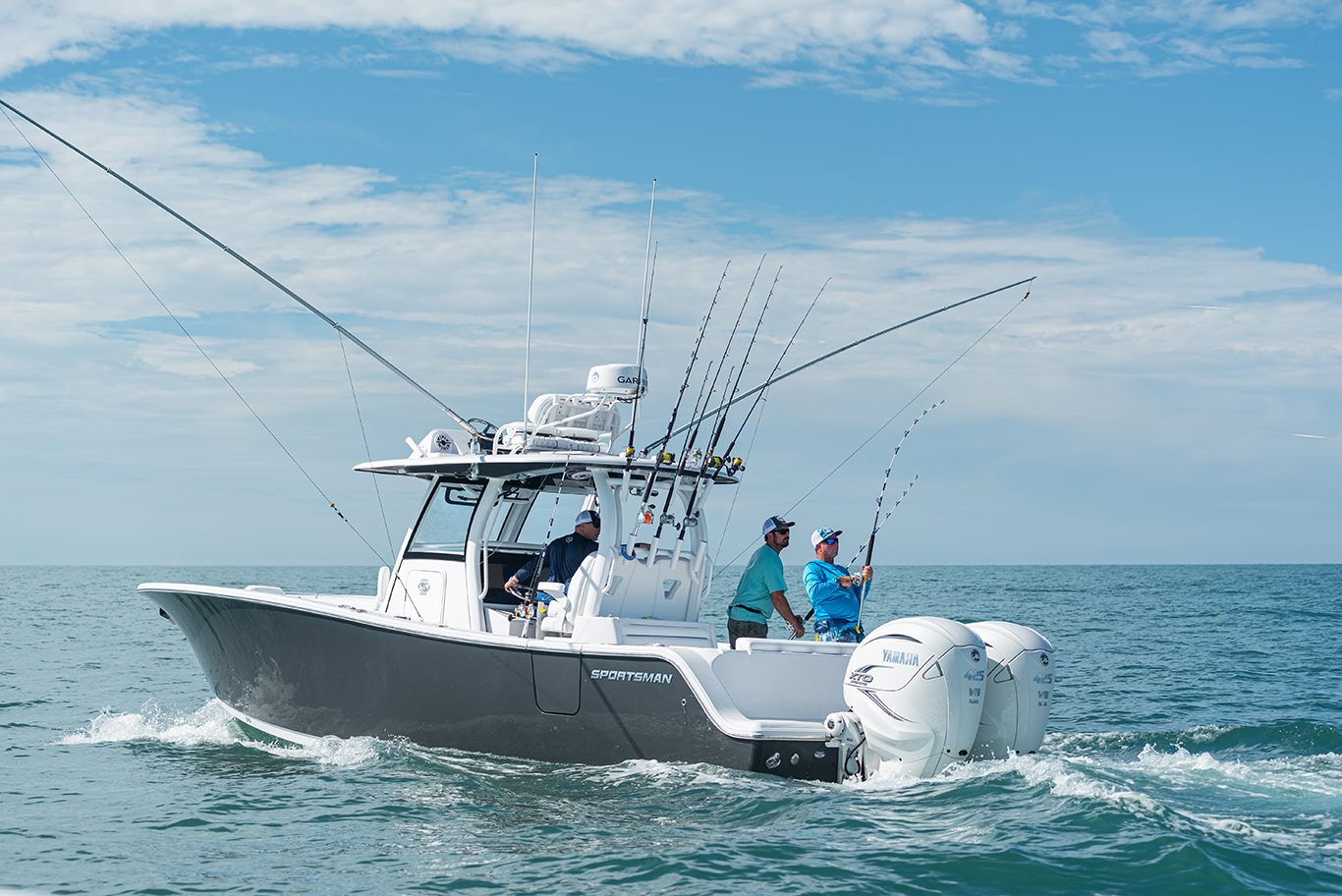
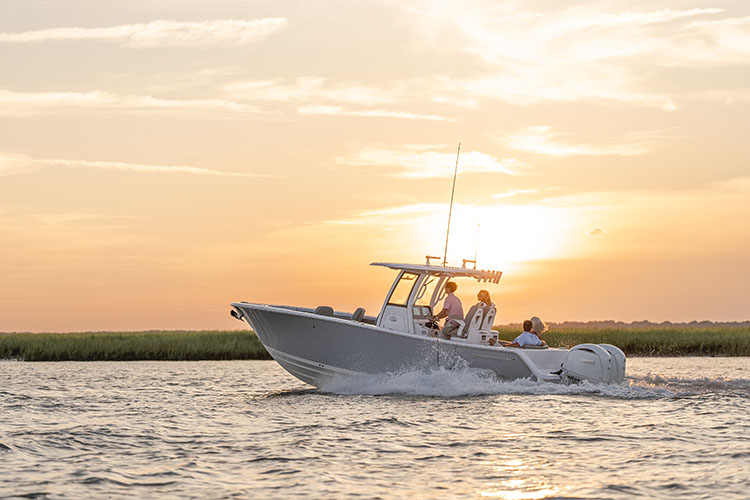
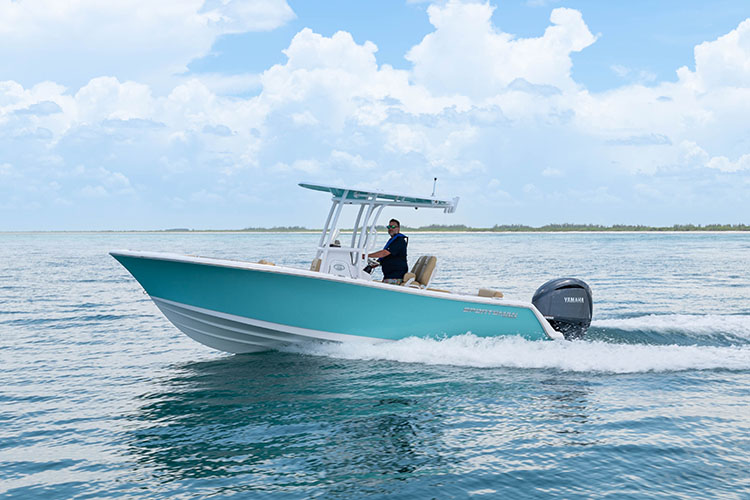
Open
Built for families who want serious offshore capability,
premium comfort and the freedom to fish, cruise or entertain.
Open 402
NEW Open 352
NEW Open 322
NEW Open 302
Open 282
Open 262
Open 252
Open 232
Open 212
Heritage
A refined crossover lineup designed for coastal cruising, ample seating,
family days and some fishing when the moment calls for it.
NEW Heritage 321
Heritage 261
NEW Heritage 251
Heritage 231
Masters
Shallow-water performance, fishing-focused layouts and
everyday comfort built for family life and fishing.
Perfect blend of offshore capabilities with inshore conveniences.
NEW Masters 288
Shallow-draft bay boats built around casting space, livewells and skinny-water fishing.
Masters 267
Masters 267OE
Masters 247
Masters 247OE
Masters 227
Sportsman Boats didn’t choose its batteries from a catalog or rely on a distributor’s recommendation. Learn why our engineering team selected Discover AGM batteries, how the independent battery banks protect critical systems and why incomplete AI data led to the wrong recommendation.

-
•Sportsman boats 26 feet and up use Discover EV31A-AM 31 Short batteries rated at 1,000 MCA for engine starting and Discover EV12A-AM 31 Tall batteries rated at 145 Ah for house and Seakeeper loads, a configuration Mercury and Yamaha explicitly approved before it ever went in a customer's boat.
-
•Independent engine, house and Seakeeper battery banks, BEP ACRs with voltage disconnect thresholds and Seakeeper's own spool-down monitoring keep your starting power protected even when onboard electronics are running hard.
-
•Treat AI as a tool rather than an engineer, because the chatbot that flagged the Discover battery at "0 MCA" simply lacked Discover's data and recommended an 800 MCA Lifeline battery that fails to meet the Mercury V10 requirement.
I’ll be honest with you. When a customer sent me a conversation they had with an AI chatbot questioning the batteries we use on our boats, I laughed.
Not because it wasn’t worth addressing, but because we have lived this decision internally at Sportsman. There was a long, arduous process of finding these batteries, vetting them and making sure they were right for our boats and our customers.
So, let me tell you how we actually got here.
It Started With a Search, Not a Suggestion
We didn’t stumble onto Discover batteries in a warehouse. We didn’t have them recommended by a distributor looking to move inventory.
Our engineering team went searching for the best possible battery for our application. We needed something that could handle the demands of a serious offshore boat, meet engine manufacturer requirements and still make sense for the value we want to deliver to our customers.
That search led us directly to the ownership team at Discover. After digging into their product line, we knew we had found what we were looking for.
On all Sportsman boats 26 feet and up, including the Open 352, we run two battery configurations:
- Discover EV31A-AM, 31 Short: Engine starting batteries
- Discover EV12A-AM, 31 Tall: House and Seakeeper batteries
There is intentionality behind both of those choices, and I want to walk you through it.
Starting Your Engine: Why MCA Is the Number That Matters
Whether you’re running Mercury or Yamaha power on your Sportsman, both engine platforms have real cranking requirements that the battery must meet.
For a Mercury V10, that number is 1,000 Marine Cranking Amps, or MCA. Yamaha’s larger outboard configurations carry similar demands at 900 MCA. The Discover 31 Short reaches the 1,000 MCA mark, which is exactly why we use it as our engine starting battery.
When the customer ran our setup through an AI chatbot, it flagged the Discover battery as having “0 MCA.” That got a chuckle out of me because the reality is that the AI simply didn’t have Discover’s data in its system.
It wasn’t making a judgment. It was working with a gap in its information.
The problem is that it then recommended a Lifeline battery as an alternative. We looked up that battery on Lifeline’s own website, and it comes in at 800 MCA. That does not meet the Mercury V10 requirement, full stop.
For what it’s worth, our engineering team didn’t simply assume our setup was acceptable. Before we ever placed this configuration in a customer’s boat, we personally contacted Mercury and Yamaha and received explicit approval.
That call happened. The setup is cleared.
I’ll also say this: these are gasoline outboards. I have never personally seen a properly sized battery fail to start a V10 or a comparable Yamaha. This isn’t a diesel application where you’re on the edge of your seat every time you hit the key.
Still, meeting the specification is the right way to do it, and we do.
Discover is also working directly with Mercury to receive an official Sportsman/Mercury Approved designation on the battery label, with the MCA and Ah ratings printed directly on it.
House and Seakeeper Batteries: Now We’re Talking Ah
Once you move past starting the engine, the conversation changes.
For your house systems and Seakeeper gyrostabilizer, the number that matters most is Amp-hours, or Ah. This rating helps indicate how long your onboard systems can operate before the batteries need to recharge.
Here is how the batteries we evaluated compare:
BatteryAh Rating Discover 31 Short (Engine)120 Ah Discover 31 Tall (House/SK)145 Ah Lifeline (AI recommendation)125 Ah Duracell (common alternative)105 Ah Odyssey (premium alternative)~200 Ah
The Discover 31 Tall delivers 145 Ah, outperforming the Lifeline battery the AI recommended and providing significantly more capacity than the Duracell alternative.
In my experience, anything below our Ah baseline will shorten your runtime on the water. That matters to us because it is something our customers will notice.
The ACR Setup and the Alternator Question
The AI also raised a concern about our BEP Automatic Charging Relay, or ACR.
The ACR is rated for 125 amps of continuous current and 140 amps intermittently. The Mercury alternator is rated for up to 150 amps of output. On paper, that may look like a mismatch.
In practice, it is not.
The engine itself draws from the alternator before any charging current reaches the batteries, which means the full 150 amps is not being pushed through the ACR.
Mercury alternators are also self-regulating. They produce the output the system demands rather than supplying a constant 150 amps at all times. When current flows toward the batteries, the batteries help absorb that charge while the ACR manages the connection between the banks.
Again, we didn’t simply take someone’s word for it. We contacted the manufacturers, discussed the configuration and received approval.
We have been running this setup without issue, and we have not experienced battery failures caused by overcharging.
Three Banks, Independent and Protected
Something that is often overlooked when discussing the battery setup on a boat like the Open 352 is that we do not run everything from one battery bank.
The engine, house and Seakeeper batteries are all organized into independent banks. That is an important detail.
The AI raised a brownout concern, suggesting that running onboard electronics could drain the batteries to the point where the engines could not be started.
With isolated battery banks, that risk is extremely low. The engine starting bank is protected from what is happening on the house or Seakeeper side.
Our ACRs can combine banks to share charging current when appropriate. That is what they are designed to do. However, they also include voltage thresholds that cause them to disconnect before one bank can pull another bank too low.
Your starting power remains protected.
The Seakeeper system also includes its own monitoring. If voltage drops, the system can gradually slow and spool down rather than shutting off abruptly. These protections are built into the system by design.
What About Other Battery Options?
The AI wasn’t wrong that other battery options exist. Here is my honest take on them.
Odyssey Batteries
Odyssey batteries are genuinely excellent. They offer more Ah capacity than the other batteries we evaluated and are a great product.
However, they cost roughly $1,500 per battery, and their form factor does not fit cleanly within our battery compartments. Accommodating them would require custom work, and custom battery installations are not practical within a standardized factory build.
If a customer wants to explore that option after delivery, it may be worth discussing with a qualified marine technician. It is not something we can currently install at the factory.
Lithium Batteries
Lithium is where the industry is headed, and I am genuinely excited about its potential.
Sportsman’s position is clear, though. We will not specify lithium batteries until every engine platform we offer has been officially approved for them.
We are not going to rush that decision at a customer’s expense.
Duracell Batteries
Duracell never came up during our original evaluation process.
We went out and found Discover. Discover did not come to us.
The Bottom Line
Our battery system, including independent battery banks, BEP ACRs and Discover AGM batteries, meets the requirements established by Mercury Marine, ABYC and NMMA.
The system functions the same way whether the boat is powered by Mercury or Yamaha outboards.
Future model-year boats will also add the EGIS battery management system, providing even more visibility and control over how each battery bank is monitored and protected.
The AI conversation was worth having because it gave us an opportunity to explain the process behind our battery selection.
The chatbot was working with incomplete information about Discover and making recommendations based only on the data it had available. What it could not see was the work our engineering team had already completed, the manufacturers we had contacted and the approvals we had received.
We are always happy to talk through the rigging and electrical systems found on our boats. This equipment matters to us, and when it matters to our customers, we are glad to get into the details.
The conversation was a good reminder that AI is a tool, not an engineer.